Table of Contents
Goods of Unknown Origin Detected at Seaports
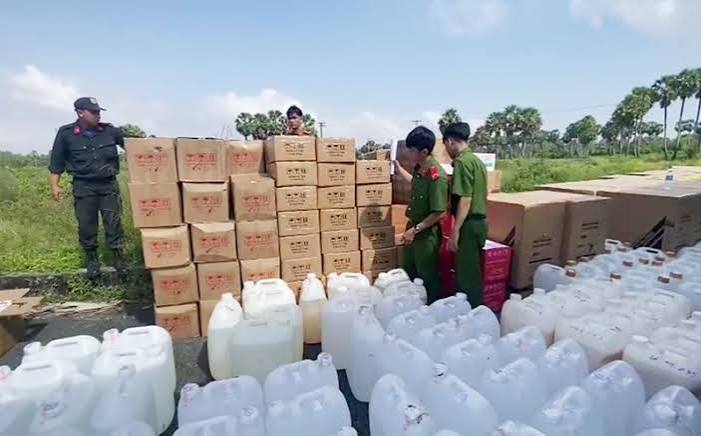
The rise of goods of unknown origin at seaports poses major risks to economic security. Customs authorities are stepping up controls to prevent commercial fraud.
Tightening customs control safeguards sản phẩm (product) integrity, stabilizes market giá cả (pricing), secures every kênh phân phối (distribution channel), and fosters a transparent environment for xúc tiến thương mại (trade promotion).
1.1. Current Reality & Risks of Unidentified Cargo
Unlabeled cargo and fraudulent origin schemes appear with increasing complexity at port yards.
1.1.1. Common Violations
-
Unlabeled Cargo: Imported shipments completely lacking manufacturer or origin details.
-
Erasing Origin Marks: Removing original labels to affix fake tags before market distribution.
1.1.2. Economic Impact
-
Revenue Losses: Non-compliant firms routinely commit customs valuation and tariff fraud.
-
Negative Consequences: Substandard goods cause direct harm to domestic consumers.
1.2. 5-Step Customs Process for Handling Cargo of Unknown Origin
Customs authorities enforce a strict operational process under statutory law:
Customs flags anomalies via scanners and immediately seals the container.
Inspection teams open containers for detailed checks and issue violation records.
Cargo samples undergo testing for quality, item classification, and valuation.
Authorities confiscate contraband, issue fines, or order mandatory re-exportation.
Large-scale cases face referral to police forces for criminal investigation.
1.3. Preventative Measures for Importing Enterprises
Enterprises must maintain compliant documentation to avoid cargo seizure risks:
1.3.1. Documentation Transparency
-
Verifying Original Labels: Ensure clear goods labeling prior to vessel loading.
-
Complete Transport Documentation: Align details across Bill of Lading, Invoice, and C/O.
-
Retaining Purchase Records: Keep complete contracts and clear international payment records.
1.4. Benefits of Tightening Unidentified Goods Controls
Blocking illicit cargo creates a healthy trading environment for compliant businesses:
1.4.1. Protecting Businesses & Consumers
-
Protecting Product Reputation: Halting fakes boosts genuine sản phẩm (product) value.
-
Balancing Market Prices: Eliminating tax-evaded items maintains fair giá cả (pricing).
-
Protecting Distribution Channels: Keeps retail networks and kênh phân phối (distribution channels) safe.
-
Promoting Trade Activities: Drives market credibility and boosts xúc tiến thương mại (trade promotion) results.
1.5. Conclusion
Controlling cargo of unknown origin is a core mission at seaports. Statutory compliance protects sản phẩm (products), stabilizes giá cả (pricing), secures kênh phân phối (distribution channels), and powers sustainable xúc tiến thương mại (trade promotion).
1.6. Related Resources
Separate Section: Frequently Asked Questions (Q&A)
Q1. How is cargo of unknown origin handled upon port detection?
Contraband is typically confiscated, fined, or ordered for mandatory re-exportation out of Vietnam.
Q2. What are the monetary fines for importing cargo of unknown origin?
Fines depend on shipment valuation per statutory customs penalty decrees.
Q3. How can a firm prove origin if labels are torn or faded?
The firm must present valid C/Os, sales contracts, and payment vouchers.
Q4. How long does it take to verify questionable cargo origin?
Verification typically takes 5 to 30 days depending on case complexity.
Q5. Does Vietship offer label and origin compliance consulting?
Yes. We review labels, audit C/O files, and provide full customs brokerage support.
