Table of Contents
Hanoi Breaks Ground on Giang Bien Inland Port: Unlocking New Momentum for Regional Logistics
Hanoi and its surrounding industrial provinces represent the premier manufacturing powerhouse of Northern Vietnam. Rapid industrialization, urban expansion, and booming commercial trade continue to place massive pressure on overland transport corridors.
Currently, freight moving between Hanoi factories and Northern deep-water marine gateways relies heavily on expressways. This heavy road dependence leads to chronic highway congestion, high freight expenditures, and elevated carbon emissions.
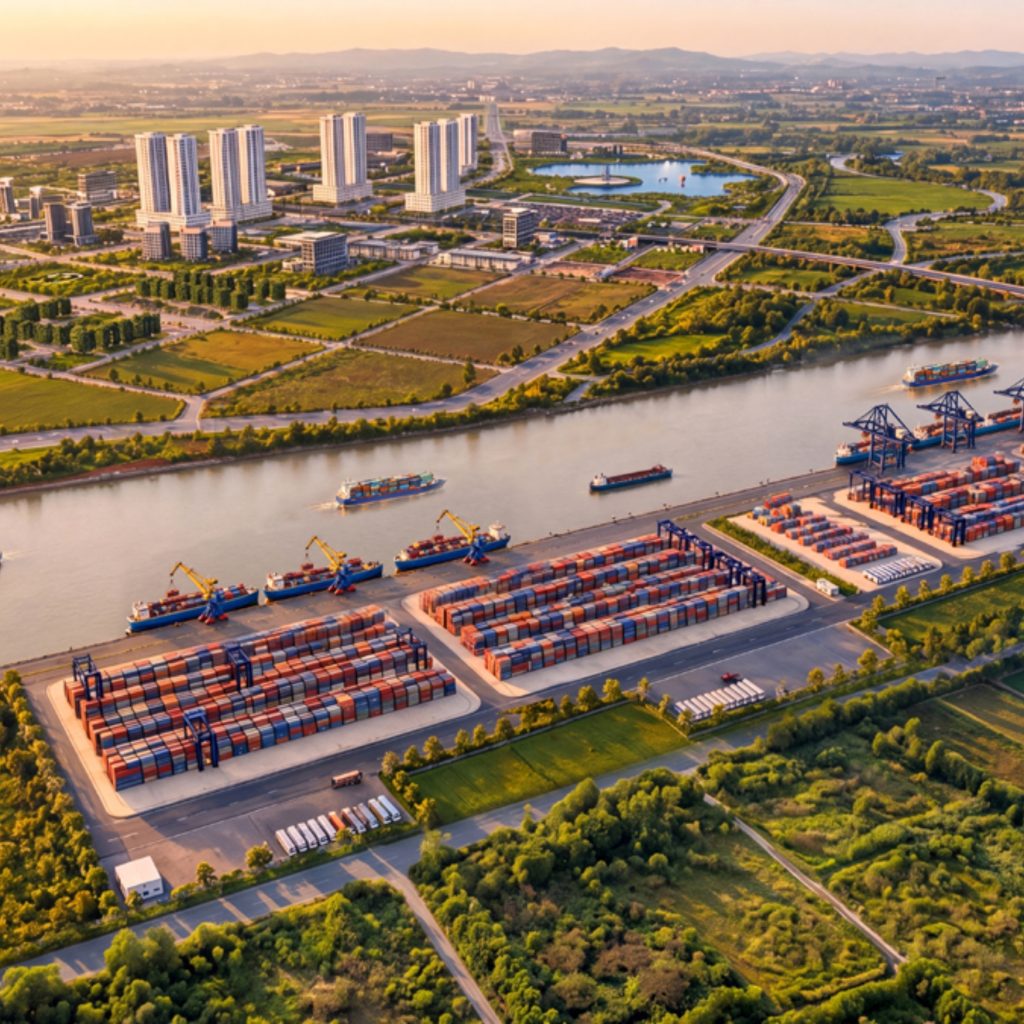
To resolve these transport bottlenecks, the capital officially commenced construction on Giang Bien Inland River Port. Positioned along the strategic Duong River corridor, this modern project establishes a critical multimodal hub connecting Hanoi directly to Haiphong’s deep-sea container terminals.
1. Project Overview and Strategic Scale
The groundbreaking of Giang Bien Inland Port marks a milestone in executing Hanoi’s master transport development plan. The facility functions as a centralized consolidation, handling, and transshipment hub for river-sea freight:
-
Total Project Investment: Approximately 2,551.8 billion VND.
-
Total Land & Water Area: Spans over 35 hectares, comprising 23.87 hectares of dedicated land and 11.23 hectares of operational water surface.
-
Designed Cargo Throughput: 2 million metric tons per year.
-
Wharf Specifications: A 600-meter continuous berthing quay designed to accommodate high-capacity river barges and container vessels.
-
Synchronized Facilities: Features modern container yards, internal road corridors, specialized technical infrastructure, administrative complexes, and green landscape buffers.
Developed by a consortium led by Hateco Group (including Hateco Logistics and the Inland Port Construction Investment Joint Stock Company), the project accelerates private investment into vital national transport assets.
2. Strategic Location on the Duong River Waterway
Giang Bien Inland Port occupies a prime geographic location on the Duong River, connecting directly to the Red River waterway system.
Specifically, the port sits along the crucial Quang Ninh – Haiphong – Hanoi inland waterway corridor. This navigation route provides a continuous, high-draft river passage linking the capital directly to northern deep-sea terminals.
Consequently, the facility is tailored for moving high-volume industrial commodities, heavy containerized freight, and project equipment over long distances. Once fully operational, the port will absorb heavy container volumes from highway routes, substantially reducing road gridlocks between Hanoi and Haiphong.
3. Multimodal Supply Chain Model: From Factory Gate to Deep-Sea Port

Giang Bien Port operates under an integrated multimodal model that leverages the unique advantages of road, river, and sea transport:
The Tri-Modal Transport Mechanism
-
First-Mile Drayage (Road): Trucks collect cargo from industrial parks, factories, and warehouses across Long Bien, Gia Lam, Bac Ninh, and Hung Yen, delivering boxes directly to Giang Bien Port.
-
Mid-Mile River Navigation (Inland Waterway): Heavy river barges transport stacked container volumes down the Duong River to Haiphong terminals. Inland barges transport large cargo batches while reducing fuel consumption and freight expenses.
-
Long-Haul Maritime Voyage (Ocean Freight): Cargo transfers seamlessly onto ocean mother vessels at deep-water terminals for international export.
For import cargo, the process operates in reverse. Containers offloaded at Haiphong ports travel upriver via barge to Giang Bien before final warehouse delivery.
4. Expanding the Hateco Logistics Ecosystem
The construction of Giang Bien Inland Port directly extends Hateco Group’s integrated supply chain ecosystem:
In maritime infrastructure, Hateco already developed and operates Hateco Haiphong International Terminal (HHIT) at Berths 5 and 6 in Lach Huyen Deep-Water Port. Concurrently, the group continues expanding terminal assets, including deep-water berths at Lien Chieu (Da Nang) and Song Chanh 3 Port (Quang Ninh).
While HHIT acts as the premier international maritime gateway in the North, Giang Bien Port functions as the inland consolidation and distribution node.
Linking deep-sea berths at Lach Huyen with an inland river port in Hanoi creates a closed-loop logistics pipeline. Export containers move smoothly from inland assembly lines through river quaysides and directly onto transpacific container liners.
5. Commercial and Environmental Benefits for Shippers
The development of Giang Bien Inland River Port delivers measurable operational benefits for Northern manufacturers:
First, shifting containerized freight from highway trucks to river barges lowers overall transportation costs by 15% to 30%.
Second, barge shipping eliminates highway traffic risks, road toll fees, and highway axle-weight fines. Shippers can safely load maximum container payloads up to 28 tons without road weight violations.
Third, river transport drastically slashes corporate carbon footprints. River barges generate significantly lower greenhouse gas emissions per ton-kilometer than fleets of diesel container tractors.
Finally, the port provides a high-capacity alternative during peak export seasons. Shippers avoid marine terminal gate queues by completing customs declarations, container stuffing, and barge loading directly at Giang Bien.
6. Driving Long-Term Regional Economic Integration
The development of Giang Bien Port aligns with the Master Plan for Hanoi (2021–2030, vision to 2050) approved under Decision 1569/QD-TTg.
In the long run, the port’s success will rely on seamless coordination with surrounding dry ports (ICDs), logistics centers, and expressway networks.
Ultimately, this project does not merely add a river berth to the Duong River. It establishes a vital multimodal trade artery linking Hanoi, northern industrial hubs, and Haiphong seaports, driving economic growth across the capital’s northeastern gateway.
Frequently Asked Questions (FAQ)
What is the designed capacity of Giang Bien Inland Port?
Giang Bien Inland Port features a 600-meter wharf capable of handling 2 million metric tons of cargo per year across a 35-hectare land and water footprint.
How does Giang Bien Port connect to Haiphong seaports?
The port connects via the Duong River and Red River waterway network directly to Haiphong’s marine terminal clusters, including the Lach Huyen deep-water container berths.
Who is developing the Giang Bien Inland Port project?
The project is invested and developed by a consortium led by Hateco Group, alongside Hateco Logistics and the Inland Port Construction Investment Joint Stock Company.
The development of Giang Bien Inland River Port marks a significant advancement for multimodal logistics in Northern Vietnam. Contact our logistics advisory team today to explore tailored barge transport options, river-sea freight connections, and cost-effective container drayage across the Hanoi – Haiphong economic corridor!
Read more:
Reliable Domestic Sea Freight Shipping from Da Nang Port to Cat Lai Port
