Table of Contents
Promoting Vietnam Coffee Exports and Strengthening Logistics Connectivity at Hamburg Port
Germany represents the single largest destination for Vietnamese coffee within the European Union. Every year, hundreds of thousands of tons of robusta and arabica beans cross maritime corridors to German roasteries.
As global supply chains demand greater traceability, port infrastructure plays a critical trade role. The Port of Hamburg serves as the primary maritime gateway for European raw coffee distribution.
Enhancing coffee exports and logistics connectivity at Hamburg Port creates massive commercial opportunities for Vietnamese enterprises. Furthermore, building integrated logistics channels helps domestic exporters navigate stringent European biosecurity, quality, and environmental regulations effortlessly.
1. Hamburg Port: The Heart of Europe’s Coffee Trade
The Port of Hamburg handles more green coffee beans than any other maritime harbor in Europe. Several distinct logistical strengths make Hamburg the premier coffee terminal:
-
Extensive Specialized Warehousing: Hamburg offers hundreds of thousands of square meters of dedicated, climate-controlled coffee storage.
-
Direct Rail and Inland Barge Links: Direct intermodal connections deliver green beans seamlessly to roasting plants across Germany, Poland, Austria, and Scandinavia.
-
Integrated Value-Added Services: Local port operators provide advanced cleaning, optical sorting, mechanical polishing, and computerized silo blending directly on quaysides.
Consequently, routing coffee shipments through Hamburg guarantees product preservation and maximizes distribution efficiency across Northern Europe.
2. Navigating the EU Deforestation Regulation (EUDR)
The European Union enforces the landmark EU Deforestation Regulation (EUDR) to curb forest degradation. Under these strict rules, coffee exporters must satisfy rigorous traceability mandates before cargo docks in Europe:
First, exporters must provide exact geographic coordinates (polygon data) for every farm producing harvested beans. European authorities reject beans harvested from land deforested after December 31, 2020.
Second, trading houses must maintain unbroken custody records across every processing and transport stage. Digital tracing systems must link farm-gate purchases directly to container stuffing tallies.
Finally, logistics operators must partner with digital trade platforms to upload due diligence statements directly to EU trade portals. Proactive compliance ensures seamless clearance upon arrival at Hamburg’s container terminals.
3. Dedicated Sea Freight and Container Configurations for Coffee
Preserving raw bean quality during a 25-to-32-day ocean voyage requires rigorous equipment management:
Full Container Load (FCL) Dry Boxes
Shippers move the vast majority of green coffee in standard 20ft General Purpose (20’GP) containers:
-
Maximized Payload: Exporters load between 19 and 21.5 metric tons of bagged coffee per 20ft container.
-
Moisture Protection: Crews line container walls and ceilings with heavy-duty kraft paper and multi-layer desiccant poles. This setup prevents condensation drip (container sweat) while passing through changing climatic zones.
Modern Bulk Liners
To cut packaging expenses, many European roasters prefer container bulk-liner bags:
-
Big Bags & Liner Systems: Workers install high-density polyethylene liners directly inside empty containers and blow loose beans inside.
-
Cost Efficiency: Bulk loading eliminates burlap jute sacks and speeds up pneumatic discharge operations at Hamburg roasting depots.
4. End-to-End Export Logistics Workflow
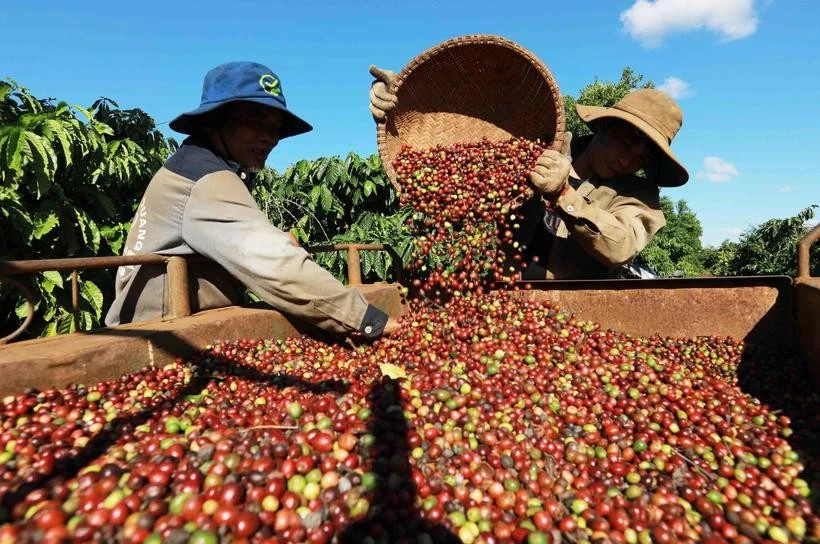
Navigating coffee shipments from Vietnamese plantations to European roasters follows five coordinated operational steps:
Step 1: Processing, Sorting, and Farm Geo-Tagging
Exporters gather beans from accredited farm cooperatives across Dak Lak, Lam Dong, and Gia Lai. In addition, quality teams record precise farm coordinates to satisfy EUDR due diligence rules.
Step 2: Quality Inspection and Pre-Shipment Fumigation
Authorized testing laboratories inspect bean moisture levels, bean size classifications, and foreign defect ratios. Furthermore, licensed providers perform phosphine fumigation to eliminate storage pests before container sealing.
Step 3: Marine Terminal Gate-In and Export Customs
Tractors haul sealed containers to deep-water terminals like Cai Mep or Cat Lai Port. Then, customs brokers submit export declarations via VNACCS and issue EU-compliant certificates of origin (EUR.1).
Step 4: Ocean Voyage via Direct Liner Services
Ocean vessels depart Vietnam and sail through the Malacca Strait, Red Sea, or around the Cape of Good Hope. Throughout the journey, satellite temperature sensors monitor container conditions continuously.
Step 5: Discharging and Value-Added Handling in Hamburg
Terminal gantry cranes discharge containers at automated container terminals in Hamburg. Finally, certified handling partners move the coffee into specialized bonded warehouses for blending and distribution.
5. Practical Recommendations for Vietnamese Exporters
Vietnamese coffee producers can expand their European market presence by adopting four practical logistics recommendations:
First, invest in digital traceability software at the farm level. Verifying deforestation-free supply chains prevents expensive customs seizures and cargo re-exports at German ports.
Second, audit moisture content rigorously prior to bag stuffing. Packaging green beans with moisture levels above 12.5% causes internal container mold during long maritime voyages.
Third, leverage tariff benefits under the EU–Vietnam Free Trade Agreement (EVFTA). Issuing accurate EUR.1 origin declarations allows German buyers to import processed coffee at 0% preferential tariffs.
Finally, partner with international freight forwarders possessing physical representations at Hamburg Port. Local forwarders navigate port release procedures, manage rail bookings, and resolve terminal exceptions swiftly.
Frequently Asked Questions (FAQ)
What is the typical ocean transit time from Vietnam to Hamburg Port?
Direct services from Cai Mep to Hamburg require approximately 25 to 30 days. Transshipment routes through Mediterranean hubs require 32 to 38 days.
How does the EUDR affect Vietnamese coffee exporters?
Exporters must prove that coffee beans do not originate from deforested land. Shippers must supply GPS polygon coordinates for each plantation before EU customs releases cargo.
What are the main advantages of using Hamburg Port for coffee distribution?
Hamburg offers dedicated temperature-controlled coffee silos, automated rail connections, and extensive on-dock value-added processing services.
Expanding coffee exports and logistics connectivity at Hamburg Port solidifies Vietnam’s standing as a world-class agricultural supplier. Contact our international logistics desk today to arrange dedicated container bookings, temperature-monitored equipment, and smooth customs clearance for your European coffee shipments!
Read more:
Professional Customs Clearance for Inward Processing and Manufacturing for Export in Vietnam
Dịch vụ book tải hàng không từ Hà Nội đi Mississippi uy tín giá rẻ
